Sigdo Koppers Rises After Disclosing Peru Sale Profit

By Nathan Gill and James Attwood      Aug. 18, 2008 (Bloomberg) — Sigdo Koppers SA, which controls Chile’s largest explosives maker, rose to the highest in two months in Santiago trading after announcing a $23.2 million pretax gain from the sale of assets in Peru.      Sigdo Koppers climbed 2.6 percent to 390.1 pesos, the… Read More Sigdo Koppers Rises After Disclosing Peru Sale Profit
Democracy Strikes Again: The End Of 21st-Century Socialism?

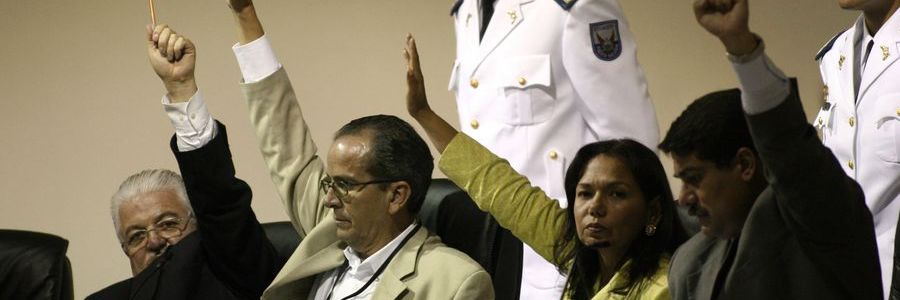
The resignation of the president of Ecuador’s Constitutional Assembly, Alberto Acosta, on June 23 is the latest in a series of setbacks for Latin America’s 21st century socialists. With political conditions deteriorating in Venezuela, Bolivia, and Ecuador, it makes sense to ask – what happened to Latin America’s socialist revolution? Where is the change their… Read More Democracy Strikes Again: The End Of 21st-Century Socialism?

Peru’s Halts Jungle Highway Construction After Investigation Shows Design Wasn’t Done

June 9, 2008 (Southern Affairs) — Peru’s Transportation and Communications Minister Verónica Zavala announced May 27th that Unasur’s highest profile project, an inter-oceanic highway connecting the Brazilian Atlantic with the Peruvian Pacific, was being investigated after discovering that it did not have a budget or engineering plans. The minister told a Congressional Committee that while… Read More Peru’s Halts Jungle Highway Construction After Investigation Shows Design Wasn’t Done

Ecuadorian Foreign Policy Traditions

What are the relevant historic issues in Ecuador’s foreign policy? Ecuador’s diplomatic history has focused strategically on the preservation of sovereign territory and resources; politically on the amplification of its national prestige and influence through multilateral institutions and economically on the promotion of national trade through close relationships with the United States, the Andean Community,… Read More Ecuadorian Foreign Policy Traditions

Ecuadorian Foreign Policy: Actors and Institutions

Who are the relevant actors in the creation of Ecuador’s national foreign policy and what structures do they operate within?  As mentioned, the current foreign policy organization is based on the institutional structure established in the 1998 Constitution. According to Article 2, “The Head of State, as Supreme Representative of the country and its sovereign… Read More Ecuadorian Foreign Policy: Actors and Institutions

South American Regional Integration Institutions: Unasur, ALADI, CAN and Mercosur

There are four regional integration institutions in South America; CAN, MERCOSUR, ALADI, and UNASUR. The first two are subregional blocks representing nine of the 12 South American member countries of Unasur; neither is fully functional. [1] All the nations of South America, except for Guyana and Surinam, are members of ALADI. Its goals are similar… Read More South American Regional Integration Institutions: Unasur, ALADI, CAN and Mercosur

Chilean Foreign Policy: 2008

What is Chile’s current foreign policy? Chile’s current foreign policy strongly resembles the foreign policy of the Portales period, emphasizing political neutrality, non-intervention, sovereign equality, regional stability, and commercial expansion. The types of problems it faces are also similar to that era, but not specific to it, insofar as it has yet to resolve territorial… Read More Chilean Foreign Policy: 2008

Chilean Foreign Policy: Traditions

What are the relevant historic issues in Chile’s foreign policy? Since the early 1830s, Chile has developed a reputation for its pragmatic foreign policy, traditionally letting national interests take precedent over ideology. Starting from at least as early as the Prieto administration there was an explicit understanding of the challenges of Chile’s situation, isolated from… Read More Chilean Foreign Policy: Traditions

Brazilian Foreign Policy: Traditions

What are the historic conditions of Brazil’s foreign policy? Like Argentina, we will divide the historic conditions of Brazil’s foreign policy into three groups; strategic, political and economic. Strategically, Brazil (and Portugal during colonial times) has sought to expand its influence in South America and the South Atlantic. At times this involved aggressive policies with… Read More Brazilian Foreign Policy: Traditions

Argentina’s Foreign Policy: Traditions

What are the relevant historic issues in Argentina’s foreign policy? The historic conditions of Argentina’s foreign policy can be divided into three groups; strategic, economic, and political. Strategically, Argentina has been preoccupied with containing Brazil and Chiles’ influence in the southern cone, Perú in the Northwest, settling border conflicts with Chile, and regaining sovereignty of… Read More Argentina’s Foreign Policy: Traditions

South American Foreign Policy: Six Case Studies

Our next several sections will focus on the national foreign policy goals of six South American nations; Argentina, Brasil, Chile, Ecuador, Peru, and Venezuela. Our criteria for selecting these countries are as follows, Argentina, Brazil, and Chile were chosen because of their historical importance in regional balance of power politics. Venezuela was chosen because of… Read More South American Foreign Policy: Six Case Studies

Historiography: Brazilian Hegemony in South America

(Mar. 31, 2008) The last explanation we will analyze here is what we are referring to as the “Brazilian hegemonic” explanation. This position holds that Brazil, given the much larger size of its population, economy, and territory relative to the rest of the region, is the natural hegemon in South American regional affairs.[1] This position… Read More Historiography: Brazilian Hegemony in South America

Historiography: Economic Explanations of South American Integration

(Mar. 29, 2008) There are several ways of approaching the question of South American integration; depending on which facet of society you choose to analyze you get a different answer. The most popular explanations are economic, historical/cultural, and Brazilian. The emphasis on economic explanations is succinctly explained by Vanden and Prevost who note, “In Latin… Read More Historiography: Economic Explanations of South American Integration

Definitions and Limitations I: Initial Assumptions on UNASUR

(Mar. 26, 2008)The decision to analyze the countries of South America as a regional subsystem of Latin America is based on the membership criteria of UNASUR itself. While it may be debatable that all of the territory southeast of Panama actually forms a single analytical subsystem, given that the region has opted for a union… Read More Definitions and Limitations I: Initial Assumptions on UNASUR

Definitions and Limitations II: Physical Borders

Geographically, South America refers to the territory located roughly between 12.5 degrees north and 56 degrees south latitude, and 34.5 east and 81.5 degrees west longitude, corresponding to the nations located southeast of Panama: Colombia, Venezuela, Guyana, Suriname, Brazil, Ecuador, Peru, Bolivia, Paraguay, Chile, Argentina, and Uruguay. Physically it is bordered by the Caribbean Sea… Read More Definitions and Limitations II: Physical Borders

Definitions and Limitations III: Regional and Extra-Regional Powers

The broad geographic zones outlined in the last entry also correspond to the general separation of historic interests in South America. According to Atkins, the economic and political interests of the Caribbean states of Colombia, Venezuela, Guyana, and Suriname have been predominantly influenced by the hegemonic influence of the United States and their respective European… Read More Definitions and Limitations III: Regional and Extra-Regional Powers

Definitions and Limitations IV: Perceptions of Shared Identity in South America

The interplay of different cultures in South America is another important factor in analyzing regional politics. The interaction between European immigrants, Africans, and later on immigrants from all over the world with the indigenous communities already living there has created a unique social atmosphere of syncretism and conflict. A crude division can be made along… Read More Definitions and Limitations IV: Perceptions of Shared Identity in South America

Problematizing Regional Integration in South America: UNASUR in the 21st Century

(Mar. 26, 2008) In South American integration literature there is a puzzling divide between primary government sources and secondary analysis. On the one hand you have a series of regional declarations signed by the 12 presidents of South American nations stating their intent to form a new continental block. On the other hand you have… Read More Problematizing Regional Integration in South America: UNASUR in the 21st Century

Ecuador Threatens More Diplomatic Problems with Colombia

(Mar. 24, 2008) The Colombian government announced Monday that the second man killed and removed during its attack on a FARC base camp in Ecuador territory was in fact Ecuadorian. The announcement seemed likely to trigger further diplomatic protests by Ecuador’s government after President Rafael Correa threatened to reopen the case last Saturday if he… Read More Ecuador Threatens More Diplomatic Problems with Colombia

Unasur Founding Summit Cancelled Over Minor Regional Conflict

Mar. 21, 2008) The March 28th meeting of South American heads of state has been cancelled because of ongoing disputes between Ecuador and Colombia. Leaders had planned to sign a foundational constitution establishing the institutional procedures for UNASUR, a new union composed of the 12 nations of South America. The cancellation was not a surprise… Read More Unasur Founding Summit Cancelled Over Minor Regional Conflict

Unasur Founding Summit Cancelled Over Regional Conflict

By Nate GillMarch 21, 2008 (Southern Affairs) — The March 28th meeting of South American heads of state has been cancelled because of ongoing disputes between Ecuador and Colombia. Leaders had planned to sign a foundational constitution establishing the institutional procedures for UNASUR, a new union composed of the 12 nations of South America. The… Read More Unasur Founding Summit Cancelled Over Regional Conflict

Counting the Chips: Political Solution Reached Between Ecuador and Colombia

(March 10, 2008) The crisis that erupted last week over Colombia’s bombing of a FARC base camp inside Ecuador seems to have come to an end. A political solution was reached between the region’s foreign ministers at the OAS special session while a more personal agreement was reached between the presidents of several Latin American… Read More Counting the Chips: Political Solution Reached Between Ecuador and Colombia

Colombian Attack Sets Off Unexpected Alarms Around South America

(March 5, 2008) On Sunday Colombia’s military bombed a Revolutionary Armed Forces of Colombia (FARC) military camp in Ecuadorian territory. The attack killed an estimated 23 rebel combatants, including FARC’s second in command, Luis Edgar Devia, a.k.a. Raúl Reyes, reportedly the first secretariat member to be killed in combat during more than 40 years of… Read More Colombian Attack Sets Off Unexpected Alarms Around South America

Interviews

I’ve spent the last two months traveling in Ecuador and Peru conducting interviews for my graduate thesis. I will be publishing these interviews in the following order: Francisco Carrión, Foreign Minister of Ecuador (2003-2006); Benjamin Ortiz, Foreign Minister of Ecuador (1998-2000); Osvaldo Hurtado, President of Ecuador (1981-1984); Rodrigo Borja, President of Ecuador (1988-1992); Carlos Espinosa,… Read More Interviews

21st Century Socialists Turn Tables On Opposition

(Nov. 30, 2007) Without delay, Ecuador’s new Constitutional Assembly approved President Rafael Correa’s proposal to close the national congress until the assembly concludes its broad reorganization of the state in what officials are calling a “Citizen Revolution.” Ecuador is the third South American country to call a Constitutional Assembly this century, joining Venezuela and Bolivia… Read More 21st Century Socialists Turn Tables On Opposition

Argentina Breaks With Venezuela Over Free Trade And Middle East

(Nov. 24, 2007) Argentina’s President Elect Cristina Kirchner distanced herself from the political agenda of Venezuela President Chávez on Monday by proposing a Mercosur-Israel free trade agreement (FTA) during her visit to Brazil. The proposal is a diplomatic counter punch to Venezuela’s open support for Iran’s President Mahmoud Ahmadinejad at the OPEC meeting in Saudi… Read More Argentina Breaks With Venezuela Over Free Trade And Middle East

South American Border Wars Slow Regional Integration

Guyana Foreign Minister Rudolph Insanally announced a temporary truce on Wednesday after Venezuela’s military blew up two Guyanese mining boats on a river near the international border. The attack took place on Nov. 15th and was part of a three day military operation, called Tepuy, to remove illegal miners from the Cuyuni River basin. Although… Read More South American Border Wars Slow Regional Integration

What Does Peru’s FTA Mean For The Rest Of The Region?

U.S. newspapers announced this week that Congress is expected to ratify a free trade agreement (FTA) with Peru before its Nov. recess. The FTA will eliminate 80 percent of U.S. export tariffs to Peru with the remaining 20 percent to be phased out over the next 10 years. While U.S. lawmakers argued over the inclusion… Read More What Does Peru’s FTA Mean For The Rest Of The Region?

Some Initial Questions: Unasur And Integration In South America

In South American integration literature there exists a puzzling divide between primary government sources and secondary analysis. On the one hand you have a series of regional declarations signed by the 12 presidents of South American nations stating their intent to form a new continental block. On the other hand you have a public that… Read More Some Initial Questions: Unasur And Integration In South America