By N. H. Gill
June 3, 2025
In 1586, a 32-year-old Franciscan friar named Luis Gerónimo de Oré began his first job in an Indigenous parish in the Colca Valley in the Peruvian Andes as an “outsider and perhaps more alone among the ‘others’ than he had been at any time in his life” (p. 91). When he left the valley nine years later, he carried with him a set of religious manuals, dictionaries, and grammars that he had written and translated into Quechua and Aymara, that would reshape the Catholic Church’s missionary efforts in the Americas. Noble David Cook and Alexandra Parma Cook’s fascinating biography, Luis Gerónimo de Oré: The World of an Andean Franciscan From the Frontiers to the Centers of Power, provides a granular exploration of the friar’s life, shedding light not only on Oré’s efforts to promote Indigenous languages, but also on his lifelong opposition to the mistreatment and enslavement of Native people.
The biography is a detailed examination of “Oré’s world and the religious beliefs that guided his life” as he moved from Peru to Spain, Italy, Florida, and Chile in the late sixteenth and early seventeenth centuries (p. 3). As the eleventh of sixteen children in a Spanish conquistador family, Oré’s childhood among the Indigenous peoples of his father’s encomienda gave him the critical cultural background and linguistic skills needed to understand and teach his Andean parishioners. Using family histories, the first chapter explores what youth would have been like for the “first creole generation” in a largely Indigenous world, including an examination of the so-called Taqi Onqoy revolt that took place at this time. Seen through Oré’s young eyes, however, the Cooks provide a complement to other classic studies of these uprisings while showing how the suffering of Indigenous communities had a lasting impact on Oré’s moral growth as a priest. Other chapters provide details about the establishment of religious orders and education of nuns and friars, as well as Oré’s participation in the Third Church Council in Lima (1581-84).
Oré’s decade as a parish friar in the Colca Valley, as well as his legal disputes with the secular clergy over control of missionary work in the area, are the focus of chapter two. Starting with his childhood and early years in Huamanga, the biography sheds light on how Indigenous resistance to the removal of the Franciscans and their refusal to accept the secular priests contributed to a broader conflict between the Church and Crown over who would exercise control in Spain’s colonial frontier. This was also a period of transculturation for both Indigenous and Spanish communities as priests like Oré endeavored to replace Andean religious practices with their own, achieving mixed results. In one case, priests tried to prevent communities in the valley from worshiping the bodies of their dead, known as huacas, by insisting that they be buried by the Church. But in this way, “the Christian churches became new huacas and the ancestors could be remembered” (p. 83). By the end of his tour in the Colca Valley, Oré had incorporated all of these experiences into a series of new texts, musical compositions, Biblical stories, dictionaries, and manuals for instructing Native communities, which he sought to publish when he returned to Lima.
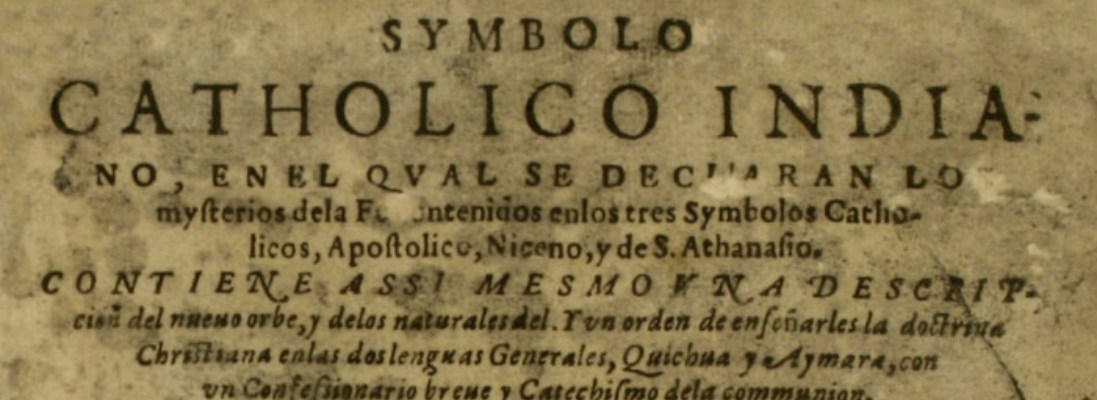
A decade after leaving the Colca Valley, Oré crossed the Pacific and Atlantic Oceans to reach Spain, where he sought license to publish three books. The first was the Sermonario de las Dominicas y Fiestas del año in Spanish, Quechua, and Aymara, and the other two were a manual to administer the sacraments and a dictionary and grammar in all three languages. Unique at the time, Oré received permission to have the books printed in Spain and, wary of the Inquisition, also sought permission from the Vatican in Rome, spending a total of six years on the Italian peninsula. His growing reputation as a theologian and linguist brought him professional recognition and new responsibilities within the church, including drafting reports on the beatification of the Spanish missionary Francisco Solano and series of Franciscan martyrs, covered in chapters three and four. Oré was also tasked with carrying out a reorganization of the Church’s missions in Florida and Cuba, including a series of tedious inspections of frontier parishes. Constant conflicts with Crown authorities and attacks by Dutch and English corsairs were also part of everyday life during these decades. More importantly, however, we see how Oré’s experience as a youth in Peru influenced his actions elsewhere, including a recommendation to implement an Andean-style resettlement of the Apalachee people of Florida to make it easier for missionaries to indoctrinate them.
The remaining chapters focus on Oré’s rise through the Church bureaucracy and transformation into a more forceful defender of Spanish empire and Indigenous rights, which were inextricably connected in his vision of a better colonial society. Along the way, Oré’s life provides insights into everything from the collective production of early Spanish chronicles to migration restrictions against people of Moorish heritage. After a brief sojourn in Lima and a last visit home to Huamanga, Oré embarks on his final mission, this time as Bishop of Concepción along the violently contested southern Chilean border. The Cooks show how Oré took an increasingly strong stance against the enslavement of Indigenous captives in places like Chile, despite owning enslaved people himself.
As the last work published by David Cook before his death in November 2024, Luis Gerónimo de Oré provides an extraordinary capstone to a career spanning over five decades. Well-written and teeming with rich details compiled over a lifetime of archival research, the Cooks’ biography joins Efraín Trelles Aréstegui’s Lucas Martínez Vegazo as indispensable reading for colonial Andean scholars. But the breadth and depth of this study also make it valuable for specialists in religious history as well as historians of the early modern Atlantic world more broadly. Finally, while not an argument-driven monograph, this work highlights the pedagogical benefits of biographies as a genre to tell broader, complex histories in ways that are accessible to both specialists and non-specialists alike.
[Editor’s Note: This review was originally published as “Luis Gerónimo de Oré: The World of an Andean Franciscan from the Frontiers to the Centers of Power, by Noble David Cook with Alexandra Parma Cook, Reviewed by N. H. Gill,” in Traces: The UNC-Chapel Hill Journal of History 13 (2025): 199–200.]
