The Process of Political Domination in Ecuador: Agustín Cueva
Citation Cueva, Agustín. The Process of Political Domination in Ecuador. New Brunswick, NJ: Transaction Books, 1982.
Citation Cueva, Agustín. The Process of Political Domination in Ecuador. New Brunswick, NJ: Transaction Books, 1982.
Stern, Steve J. Peru’s Indian Peoples and the Challenge of Spanish Conquest: Huamanga to 1640. Madison, Wis: University of Wisconsin Press, 1982. Steve Stern’s Peru’s Indian Peoples and the Challenge of Spanish Conquest: Huamanga to 1640 centers on colonial Huamanga, a strategic military and economic region along the route between Lima and Potosí. It was… Read More Peru’s Indian Peoples and the Challenge of Spanish Conquest: Steve Stern
David Chandler’s “Slave Over Master in Colonial Colombia and Ecuador” (1982) looks at the development of the institution of slavery and the legal rights of enslaved Africans in the colonial Andes. Chandler argues that slavery as it was practiced in relatively peripheral parts of the Spanish Americas, like Colombia and Ecuador, was different than in… Read More Slave over Master in Colonial Colombia and Ecuador: David Chandler
Citation Van Aken, Mark. “The Lingering Death of Indian Tribute in Ecuador.” The Hispanic American Historical Review 61, no. 3 (1981): 429–59.
Citation Lebret, Iveline. La vida en Otavalo en el siglo XVIII. Otavalo, Ecuador: Otavalo, Ecuador : Instituto Otavaleño de Antropología, 1981.
Horacio Larraín Barros’ Demografía y Asentamientos Indígenas En La Sierra Norte Del Ecuador En El Siglo XVI: Estudio Etnohistórico de Las Fuentes Tempranas, 1525-1600 (1980) is an ethnohistory of the northern Andean región in the Incan and Spanish colonial periods which sheds light on the impact of Incan attempts to reorganize life in what became… Read More Demografía y Asentamientos Indígenas en la Sierra Norte del Ecuador en el Siglo XVI: Horacio Larraín
Citation Hamerly, Michael T. “Quantifying the Nineteenth Century: The Ministry Reports and Gazettes of Ecuador as Quantitative Sources.” Latin American Research Review 13, no. 2 (1978): 138–56.
Jürgen Golte’s Repartos y Rebeliones, published in German in 1977 and translated into Spanish by Carlos Degregori in 1980, analyzes the implementation, evolution, and resistance to the repartimiento de efectos, put in place by Spain’s Bourbon reformers in the eighteenth century.[1] Golte sought to revise earlier studies that overlooked the role of the repartos, a… Read More Repartos y Rebeliones: Jürgen Golte
Segundo Moreno Yánez’s Sublevaciones Indigenas En La Audiencia de Quito. Desde Comienzos Del Siglo XVIII Hasta Finales de La Colonia (1977) looks at ten riots, protests and other tumultos in colonial Quito between 1760 and 1803. Moreno argues that conflicts over labor and a lack of trust between Andean communities and the colony’s Creole elite… Read More Sublevaciones Indigenas en la Audiencia de Quito: Segundo Moreno
Robert Keith’s 1976 Conquest and Agrarian Change: The Emergence of the Hacienda System on the Peruvian Coast, explored the rise of Spanish plantations in seven valleys along Peru’s southern coast in the second half of the sixteenth century. Keith emphasized the legacy of pre-Colombian societies in the development of the hacienda, arguing that in addition… Read More Conquest and Agrarian Change: Robert Keith
Citation Plaza Schuller, Fernando. La Incursión Inca En El Septentrión Andino Ecuatoriano: Antecedentes Arqueológicos de La Convulsiva Situación de Contacto Cultural : Primer Informe Preliminar. Otavalo, Ecuador: Instituto Otavaleño de Antropología, 1976.
Emilio Bonifaz’s Los Indigenas de Altura Del Ecuador (1979) is an agricultural history of Ecuador’s northern highlands in the nineteenth and early twentieth centuries, told from the viewpoint of one of the country’s wealthiest elites. While much of the social analysis of indigenous communities is based on now-discredited theories of scientific racism, his study of… Read More Los Indigenas de Altura del Ecuador: Emilio Bonifaz
Citation Bromley, Rosemary D. F., and R. J. Bromley. “The Debate on Sunday Markets in Nineteenth-Century Ecuador.” Journal of Latin American Studies 7, no. 1 (1975): 85–108.
John Murra developed his now-famous theory of the Andean “vertical archipelago” in Formaciones Económicas y Políticas del Mundo Andino (1975, trans. Economic Organization of the Inka State, 1980), which grew out of his research in the Peruvian highlands between 1958 and 1973. Murra argued that pre-Columbian societies in the Andes sought to control a range of ecological zones… Read More Economic Organization of the Inka State: John Murra
Anthropologist Thomas Greaves’ 1972 article, “The Andean Rural Proletarians” examined the critical role played by labor syndicates in the organization of regional peasant movements in the Ecuadorian highlands during the twentieth century. Greaves applies Sidney Mintz’s concept of the “rural proletarian” to the Andes to narrow what was then thought to constitute the so-called peasant… Read More Andean Rural Proletarians: Thomas Greaves
Citation Albornoz Peralta, Osvaldo. Las luchas indigenas en el Ecuador. Guayaquil: Editorial Claridad S.A., 1971
Anthropologist Muriel Crespi’s 1971 article, “Changing Power Relations: The Rise of Peasant Unions on Traditional Ecuadorian Haciendas,” explored the disruptive consequences of agrarian capitalism on rural authority structures in the mid-twentieth century. Focusing on the expropriation of Church-owned haciendas and the rise of Marxist-inspired peasant unions in the Ecuadorian highlands near Cayambe, Crespi argued that… Read More The Rise of Peasant Unions on Traditional Ecuadorian Haciendas: Muriel Crespi
Citation Bonifaz, Emilio. “Origen y evolución de una hacienda histórica: Guachalá’ II” Boletin de la Academia Nacional de Historia (BANH) 53, no. 115 (January-June 1970): 115-22.
When historian James Lockhart published his renown article “Encomienda and Hacienda” in 1969, the modern historiography on haciendas was already more than forty-years-old. Yet even after decades, scholars were only beginning to understand these New World estates in terms of their origins and functions as colonial institutions. Early twentieth century scholars debated the extent of… Read More Encomienda and Hacienda: James Lockhart
John Phelan’s The Kingdom of Quito in the Seventeenth Century: Bureaucratic Politics in the Spanish Empire (1967) looks at the emergence of administrative and bureaucratic institutions in the colonial Americas through the lens of early seventeenth-century Audiencia de Quito. Focusing on Antonio de Morga, the president of the audiencia between 1615 and 1636, Phelan argues… Read More The Kingdom of Quito in the Seventeenth Century: John Phelan
Citation Vargas, José María. Don Hernando de Santillán y La Fundación de La Real Audiencia de Quito. Quito: Editorial Casa de la Cultura Ecuatoriana, 1963.
Citation Larrea, Carlos Manuel. La Real Audiencia de Quito y su territorio. Quito: Editorial Casa de la Cultura Ecuatoriana, 1963.
CitationBarrera, Isaac J. Ensayo de interpretación histórica : introducción a los acontecimientos del 10 de agosto de 1809. Quito: Editorial Casa de la Cultura Ecuatoriana, 1959.
Citation Carrera Andrade, Jorge. La tierra siempre verde : El Ecuador visto por los cronistas de Indias, los corsarios y los viajeros ilustres. Paris: Ediciones Internacionales, 1955.
Citation Velasco, Juan de, and Raúl Reyes y Reyes. Historia moderna del reyno de Quito y crónica de la provincia de la Compañía de Jesús del mismo reyno. Quito: Imprenta de la Caja del Seguro, 1941.
Citation Saville, Marshall H. and Pedro de Alvarado. A Letter of Pedro de Alvarado Relating to His Expedition to Ecuador. New York: Museum of the American Indian, Heye Foundation, 1917.

“Volcán de Pacaya y Terrenos Adyacentes: ‘Golpe de Vista Que Ha Pintado Un Curioso y Demuestra El Bolcán Desde El Paraxe No 1 En Que Se Puso a Reconocerlo.’” Guatemala, July 26, 1775. MP-GUATEMALA, 315. Archivo General de Indias.
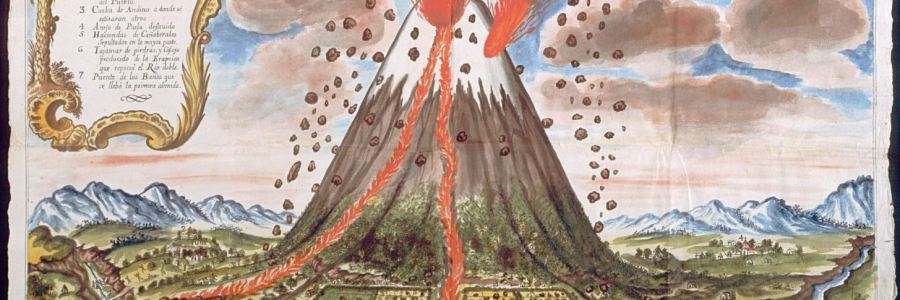
AGI. “Perspectiva del Bolcan de Tunguragua en la Provincia de Quito y de Su Erupción el Día 23 de Abril de 1773.” Quito, August 16, 1773. MP-PANAMA,180. Archivo General de Indias.
