Miners of the Red Mountain (Review)
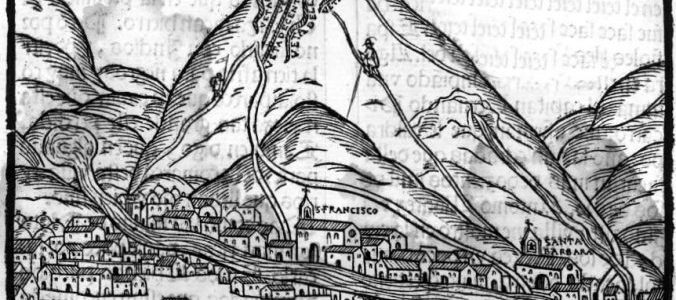
Peter Bakewell’s Miners of the Red Mountain: Indian Labor in Potosí, 1545-1650 (1984) looks at the changing systems of labor and production used at the silver mines of Potosí in the late sixteenth and early seventeenth centuries. Bakewell questions the long-held assumption that the mines were overwhelmingly worked by forced laborers, arguing instead that declining silver output and new refining technologies fueled the growth of a competitive market for specialized, wage-earning workers.… Read More Miners of the Red Mountain (Review)

Changes in the Land: William Cronon

William Cronon’s Changes in the Land: Indians, Colonists, and the Ecology of New England (1983) looks at environmental change and human landscaping in pre-Columbian and colonial New England. Cronon argues that what we think of as “nature” on the so-called American frontier was not an untouched and pristine wilderness, but a heavily landscaped environment where… Read More Changes in the Land: William Cronon

Peru’s Indian Peoples and the Challenge of Spanish Conquest: Steve Stern

Stern, Steve J. Peru’s Indian Peoples and the Challenge of Spanish Conquest: Huamanga to 1640. Madison, Wis: University of Wisconsin Press, 1982. Steve Stern’s Peru’s Indian Peoples and the Challenge of Spanish Conquest: Huamanga to 1640 centers on colonial Huamanga, a strategic military and economic region along the route between Lima and Potosí. It was… Read More Peru’s Indian Peoples and the Challenge of Spanish Conquest: Steve Stern

Conquest and Agrarian Change: Robert Keith

Robert Keith’s 1976 Conquest and Agrarian Change: The Emergence of the Hacienda System on the Peruvian Coast, explored the rise of Spanish plantations in seven valleys along Peru’s southern coast in the second half of the sixteenth century. Keith emphasized the legacy of pre-Colombian societies in the development of the hacienda, arguing that in addition… Read More Conquest and Agrarian Change: Robert Keith

Los Indigenas de Altura del Ecuador: Emilio Bonifaz

Emilio Bonifaz’s Los Indigenas de Altura Del Ecuador (1979) is an agricultural history of Ecuador’s northern highlands in the nineteenth and early twentieth centuries, told from the viewpoint of one of the country’s wealthiest elites. While much of the social analysis of indigenous communities is based on now-discredited theories of scientific racism, his study of… Read More Los Indigenas de Altura del Ecuador: Emilio Bonifaz

Economic Organization of the Inka State: John Murra

John Murra developed his now-famous theory of the Andean “vertical archipelago” in Formaciones Económicas y Políticas del Mundo Andino (1975, trans. Economic Organization of the Inka State, 1980), which grew out of his research in the Peruvian highlands between 1958 and 1973. Murra argued that pre-Columbian societies in the Andes sought to control a range of ecological zones… Read More Economic Organization of the Inka State: John Murra